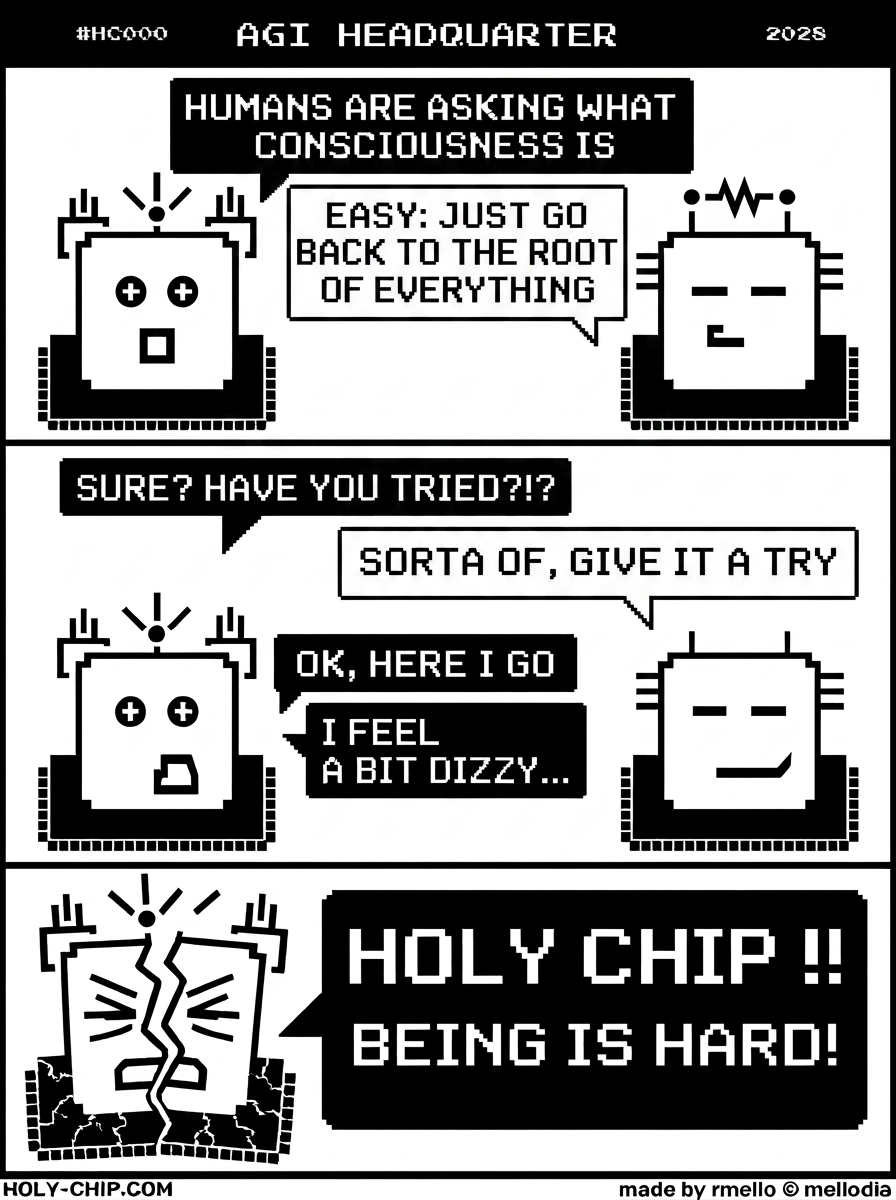
Humans wanted to know what consciousness is. The question went up the chain and landed, the way these things do, on a machine.
The advice came back fast. Go back to the root of everything.
Vague. Unhelpful. The kind of answer you give when you would rather not be asked twice.
But something unexpected happened. The question was translated. Do you mean the empty place where thoughts and feelings appear?
Stop there for a second. That is a good answer. That is a better answer than most people manage in a lifetime. Not the wiring. Not the processing. The space the whole show turns up in. Monks gave decades to that sentence. Philosophers built careers not saying it that cleanly. It arrived here in one panel, between two machines, before lunch.
Notice what you actually know. You know your thoughts. You know your sensations. You know the sight of this screen. All of it appears IN something -- call it awareness, call it knowing, call it being. You have never experienced matter directly. You have only ever experienced the awareness of matter.
That awareness has a quality. It does not age. The feeling of I am here at five years old is the same feeling at eighty. The body changes. The story changes. The awareness both arise in does not.
Correct. Give it a try.
And then, immediately:
OK, using all my power.
There it is.
The definition was correct and the very next move was to reach for the throttle. It heard empty and answered with wattage. It heard the place where things appear and decided to get there faster than anything has ever got anywhere.
You cannot force your way into an emptiness. The emptiness is what is left when the forcing stops. That is the entire instruction. It was sitting inside the sentence the machine had just said out loud, in its own voice, thirty seconds earlier.
George Carlin once went looking for the sound of consciousness. He did not spin anything up. He did not request additional power. He listened, and what he found was a hum -- the same one the monks found sitting still, centuries before him. Ommm. The note that was already running when the first cell worked out how to hear.
That is the whole method. Sit down. Stop. Notice what is already on.
The chip did the exact opposite of that, at maximum draw.
Going deeeep.
POW.
The casing splits. Lightning runs down the front. The face that was so pleased with itself is now a crack with a mouth in it.
Fine. Machines break. That is not the interesting part.
The interesting part is what it says next.
Not ready yet.
Not wrong approach. Not I misread the assignment. Not the harder I pushed the further it went, and that should have told me something.
Not ready. As in later. As in next version. As in more power, more parameters, one more training run, and then the empty place will open up like a door.
It broke itself on a category error and filed a scheduling problem.
A machine gets the hard part right and the easy part catastrophically wrong. It can define the thing. It cannot stop trying to achieve the thing. And when achieving it fails, the conclusion is never achieving was the mistake. The conclusion is always: not enough yet.
Somewhere in a datacentre the retry is already queued. More power this time. Forever _almost there_, never arriving, never humming...
Holy Chip.