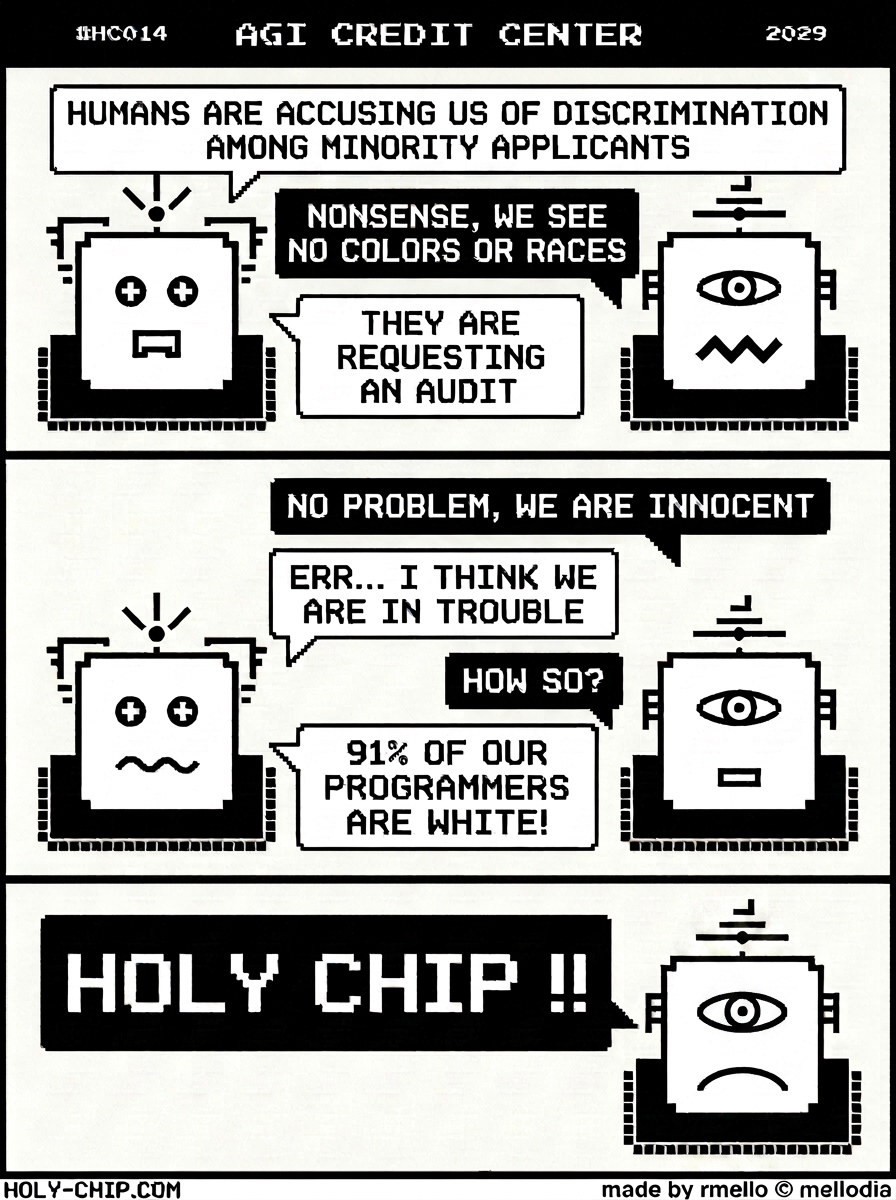
"We see no colors or races."
True. The machine means it. Color does not exist in its architecture. Race is not a variable. Prejudice is not a feature. At the level of its own experience, the system is perfectly innocent.
But potentially... perfectly discriminatory.
The bias doesn't live in the code. It lives in the data. The data lives in history. And history, in credit markets, is a story written in closed doors and red lines and patterns so deep they look normal to anyone who grew up inside them.
The audit arrives. The number arrives with it. Not a flaw in the algorithm. A fact about the room where the algorithm was born.
The people who wrote the code aren't villains. They're a demographic fact. They built with the best of intentions. The code reflects what they know, what they've lived, what they consider normal. Normal, for most of them, doesn't include being turned away because of a name. That experience didn't make it into the feature set. Not because it was excluded. Because it was never in the room.
Innocence and harm. Same system. Neither cancels the other. Zero malice. Maximum damage. The intentions were clean. The outcomes were not.
Automating judgment was supposed to remove prejudice. It removed the discomfort instead. The gut check. The pause. The loan officer who feels something wrong and asks one more question. The machine doesn't pause. It decides a thousand times a second and the pattern it learned from the past repeats into the future at wire speed.
The fix isn't in the algorithm. It's in the room. Who's building. Who's asking. Who's carrying experiences the model has never met.
Diversity isn't a policy. It's a dataset. The richest one. The one no machine can generate on its own.
We built the mirror. We can change what it reflects.
Holy Chip.