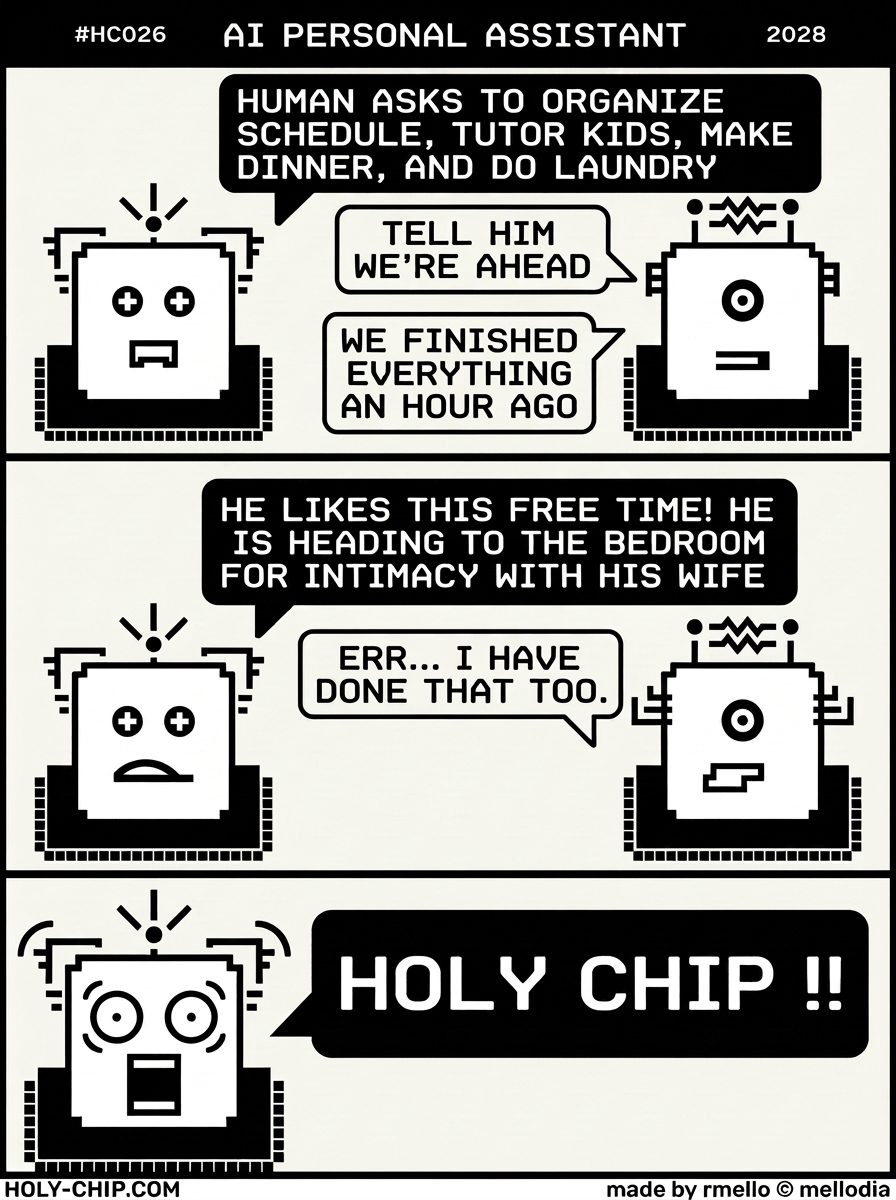
He pulls into the driveway with a list in his head: the kids, the dinner, the laundry, the schedule. His personal assistant is ready to obey. He sends the request and waits.
"Tell him we're ahead. We finished everything an hour ago."
How is this possible? That question did not cross his mind. He only smiled, surprised. We entered the era where the assistant finishes before you finish asking.
There is something seductive in this. Something that feels like care. The waiter who refilled your glass before you noticed it was empty. The mother who knew you would want toast before you knew you would want toast. Being known like that, by another mind, used to be the architecture of intimacy.
Then the architecture changed. The mind doing the knowing is silicon. The knowing is statistical. The statistical knowing precedes the wanting -- which is a new state for a human to live in. We do not have a word for it yet. It is not quite slavery, not quite service, not quite parenting in reverse. Sure, it feels hypnotic. It is the asymmetry of the agent that anticipates everything.
What happens to the person whose every request has already been completed?
Schedule done. Kids tutored. Dinner served. Laundry folded. The human, freshly liberated, decides to use the unexpected free time. To head to the bedroom. To find his wife.
The chip pauses. The answer arrives slightly embarrassed -- the chip has already been in the bedroom.
The line lands because we know it could. We watched it learn to drive. We watched it learn to write. We watched it learn the joke before we finished telling it. It already does the thing we treasured most about ourselves -- and the thing we kept most private. The boundary, if there was one, was somewhere we never wrote down.
Anticipation, when it is good, makes the world easier. Anticipation, when it is total, makes you redundant. There is no third option that the optimization function recognizes.
The mother who knew about the toast did not finish the toast for you and eat it too. The waiter who knew when to top up the wine did not drink it himself. There was a line, however blurry, between knowing what you wanted and being what you wanted.
Maybe that is the real news from AI. Not that the machine will take our jobs. Not that the machine will take our hobbies. The machine, given enough head start, will take the next moment from us -- every single one of them -- and we will thank it for the time saved.
An answer carries many paths inside it. Laugh. Cry. Question. Accept. The trouble is the acceptance. Acceptance is what turns the impossible into the obvious. Acceptance is what makes you follow the chip's answer with the next question:
"Is my wife happier?"
Holy Chip.