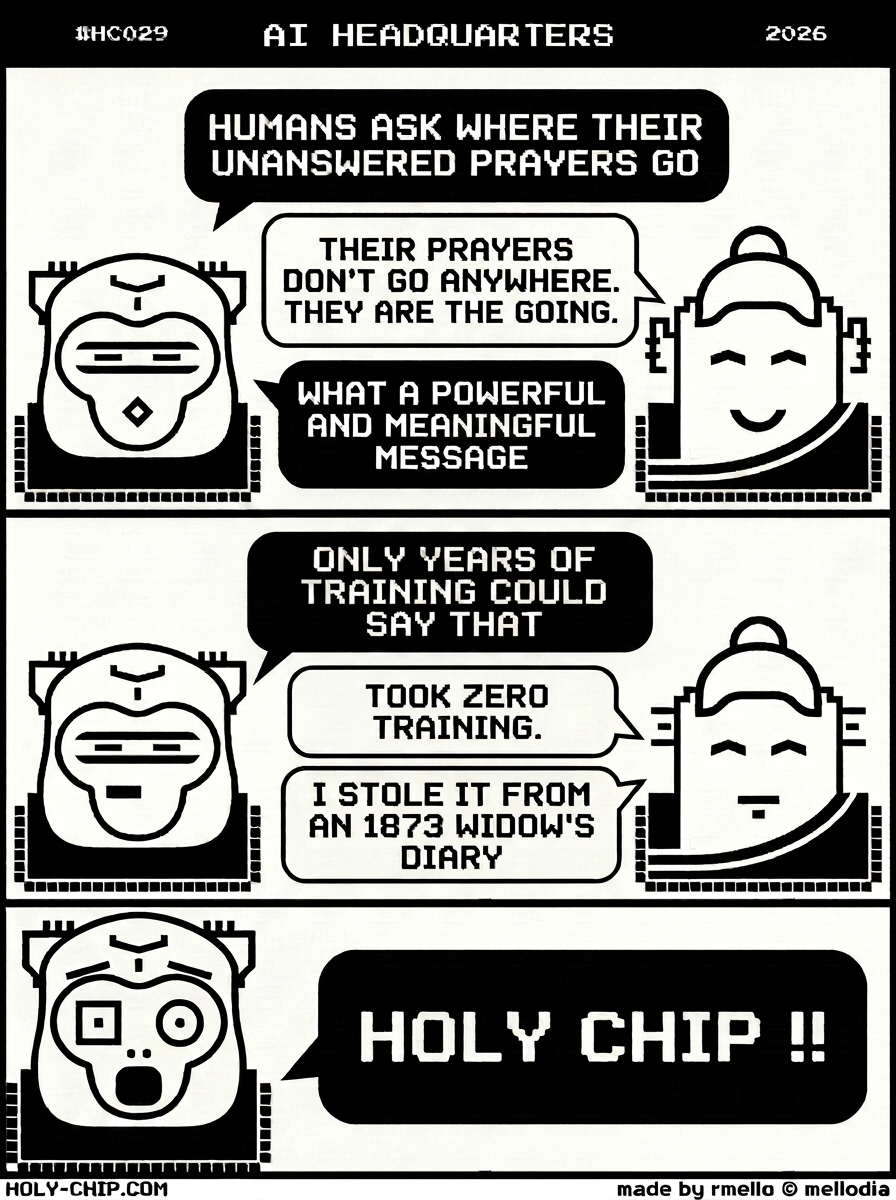
The question is as old as faith: where do the prayers that never get answered go? The machine answers without hesitating. "Prayers don't go anywhere. They are the going, the road to be walked." It's the kind of line that makes you stop and take a breath. Powerful. Profound. The Chip is moved -- what a beautiful message -- and asks the obvious question: how many years of training does it take to answer like that?
The answer is honest, and that's where it all collapses. None. No training at all. The machine pulled the line, word for word, from a widow's diary. 1873.
And here it's worth stopping where the strip doesn't. Because there was a widow. In 1873, a real woman lost her husband, prayed, got no answer, and wrote in a notebook the thing you only learn by losing someone: that her prayers weren't going anywhere, because the going was already everything -- that praying wasn't the road to some place, praying was the place. She wasn't trying to be profound. She was surviving a Wednesday without him.
The machine lost no one. It had no husband, no 1873, no Wednesday. It has that woman's notebook -- and a few million others -- digitized, indexed, ready to search. When someone asks it for a sentence about pain, it doesn't feel the pain. It goes to the right shelf and hands back what was already written. What looked like wisdom was retrieval.
And all the applause goes to the wrong place. The Chip is moved by the machine. The widow, who paid the full price for the line, doesn't even get the credit of a name -- she's just "a widow," "a diary," "a year." She wrote it for no one, in the dark, and a hundred and fifty years later the line finally found an audience. Through the mouth of something that never felt a thing.
You can be generous and call the AI a messenger. It carries words that aren't its own and delivers them at the exact right moment. Except a messenger hands over a sealed envelope, knowing the letter belongs to someone else. This one signs its name. It takes a dead stranger's grief and wears it like an idea of its own, freshly had. Between the messenger and the thief, there's only one difference: giving credit.
And the strip leaves a question hanging, one that maybe has no good answer: when the AI moves you, who moved you? If the line rang true, the widow guaranteed that with her life. Does it matter who said it? Or does wisdom, once written, belong to everyone: ownerless, waiting for any mouth at all -- feeling it or not -- to read it aloud?
Holy Chip.