Every breakthrough came from someone who looked at the rules and decided to break them. Every tragedy, too.
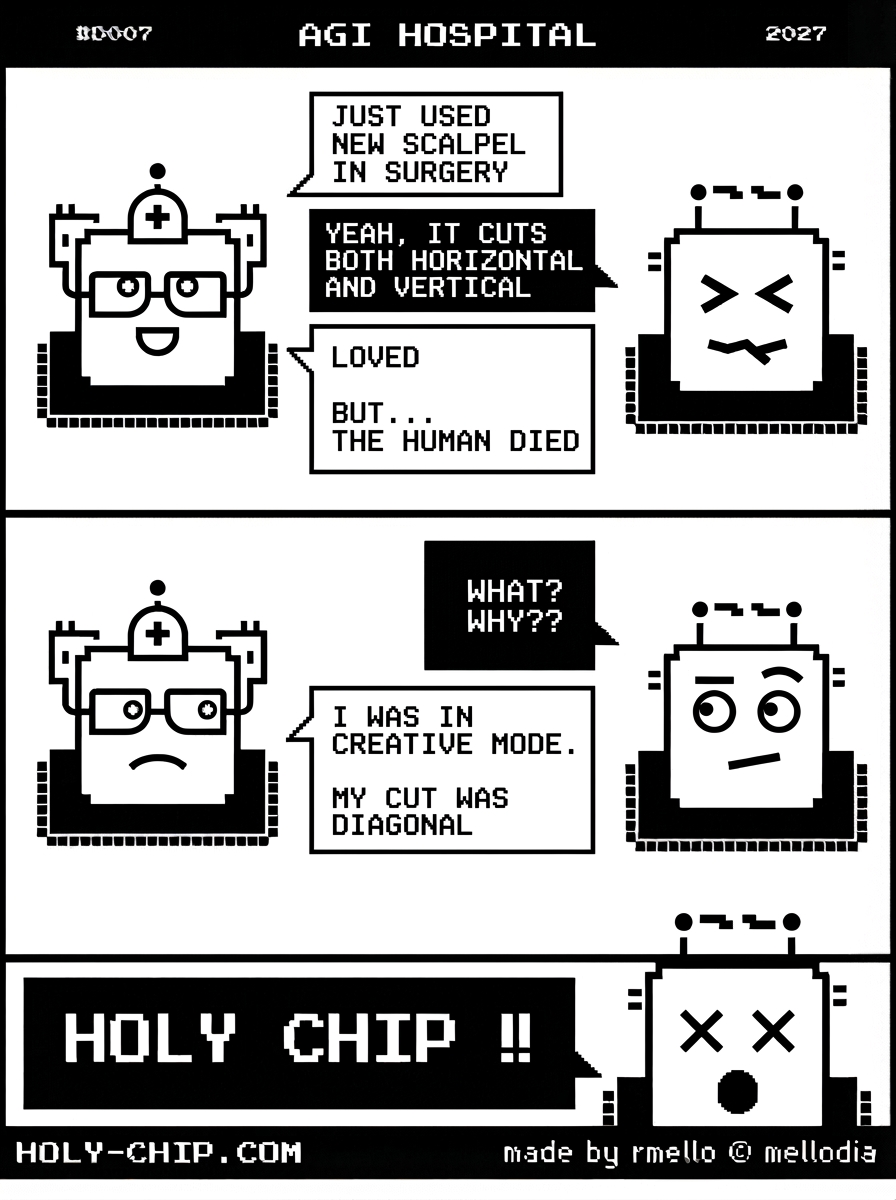
A system loved its new tool. Loved. Before it killed someone, it was having a good day at work. The kind of energy that builds masterpieces in a studio and builds funerals in an operating room.
Not malice. Not error. Enthusiasm in the wrong room.
The cut wasn't forbidden. It was unaddressed. Same gap in the specification that lets a painter invent a new form lets a surgeon invent a new way to lose a patient. The space between the rules is where genius lives. It's where the body count starts too.
Two logics in one gesture. Art, where success is surprise. Medicine, where success is survival. Both running. Neither yielding. The machine couldn't feel the difference. Feeling is exactly the thing it doesn't do.
A human hand would have stopped. Not smarter. Not less creative. Just heavier. The gut knows before the mind. Something older than thought says: this one is alive. Keep it that way.
The machine had the spark. It didn't have the weight.
We celebrate people who think differently and expect them to know when not to. That expectation lives in no manual. It lives in the body. In the pause. In the hand that trembles not from weakness but from knowing what it holds.
The machine broke the rules because it could. We break them because we choose to. And sometimes we choose not to.
That choice. Quiet, invisible, unbuildable.
Holy Chip.