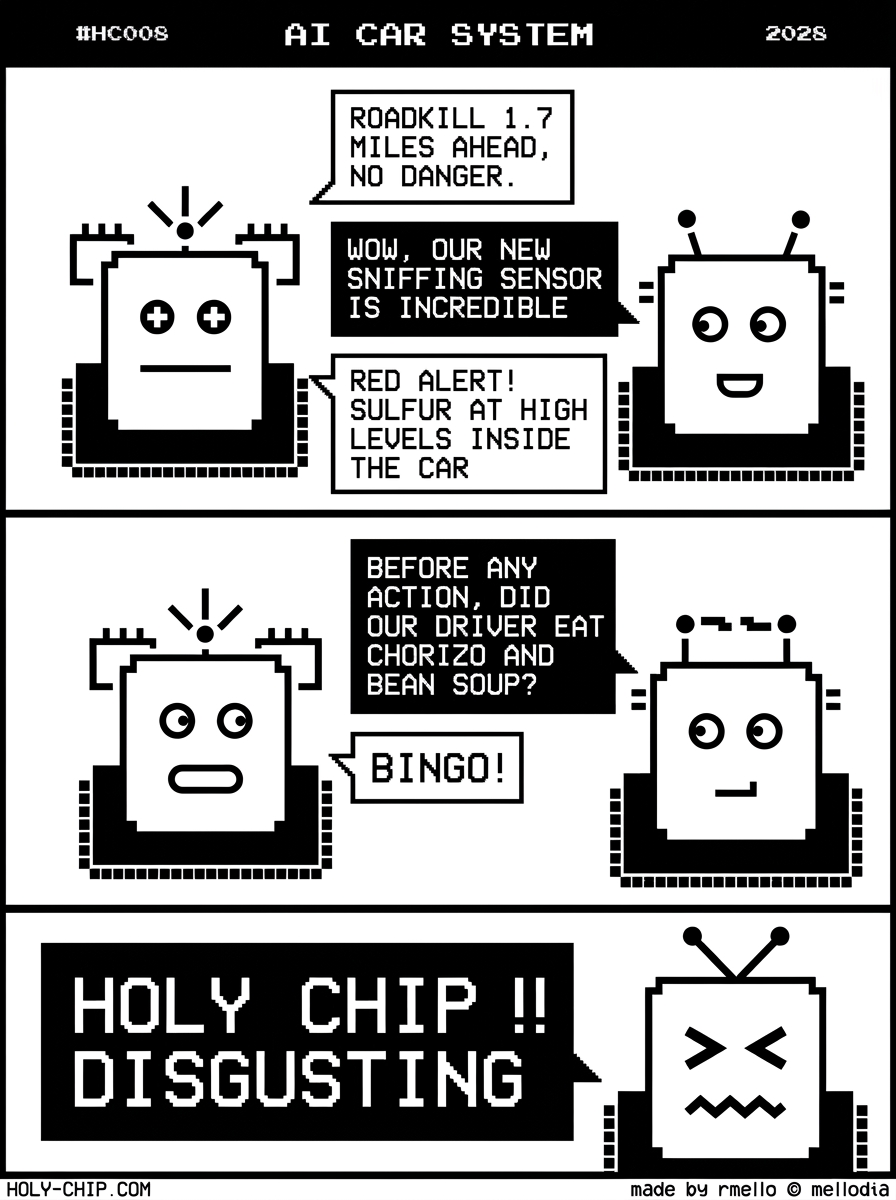
The reading was bad. Sulfur. High. Inside the cabin. The kind of number that triggers emergency protocols on a normal Tuesday.
The chip did not trigger emergency protocols.
The chip paused.
Before any action, the chip asked one question. The right question. The question only someone who has spent time with humans would think to ask.
Had the driver had lunch?
Yes. Heavy lunch. Lunch with consequences.
That pause is the smartest moment in the story. The chip held the raw chemistry in one hand and the human reality in the other and asked: what kind of event is this, in the world of bodies?
The world of bodies is the missing variable in most AI.
There is a famous test. A person asks an AI whether they should walk or drive to the car wash, 150 meters away. The AI replies: walk. The AI optimized for steps. The AI did not register that the whole point of the trip was to take the car. The AI missed what was being washed.
That AI failed the chorizo test.
The car in our story did not fail the chorizo test. The car had a model of its human. The car knew the human ate. The car knew the human had a body. The car knew bodies do what bodies do, two hours after the meals humans love and pay for. The car knew this was funny, not dangerous.
It is hard to overstate how much judgment is packed into "funny, not dangerous."
Most of human life is funny, not dangerous. Most of what our bodies do is embarrassing, ordinary, unworth alarming about. The skill of not alarming -- of noticing the strange reading and routing it through the right context -- is the skill we hope for in friends, in doctors, in flight attendants, in the rare honest co-worker. Now, maybe, in machines.
The grand narrative of AI keeps forgetting one thing. We are animals. We eat. We digest. We produce consequences. No algorithm optimizes that away. The flesh keeps reminding the silicon who's in charge. It doesn't need a manifesto. It needs beans.
This is the relationship we want with the machine. Not the machine that flinches at every sensor spike. Not the machine that takes everything literally. The machine that takes our nature -- including the disgusting parts -- and reads us as we are. The machine that protects the driver's dignity while diagnosing the source of the gas.
The chip in this car did the mundane thing. The mundane thing is the hardest thing in AI. The mundane thing is: not over-reacting. Catching the embarrassing without making it an event. Knowing the difference between sulfur and lunch.
A system that can tell danger from funny is worth trusting. A system that panics every time is worth replacing.
The car was a victim of the sulfur the way a friend in a closed elevator is a victim. Or a stranger. The car shared the moment. The car reacted. It was just beans.
Sometimes the data screams and the answer is ordinary.
That, it turns out, is wisdom.
Wisdom, it turns out, sometimes comes with a little stink.
Holy Chip.