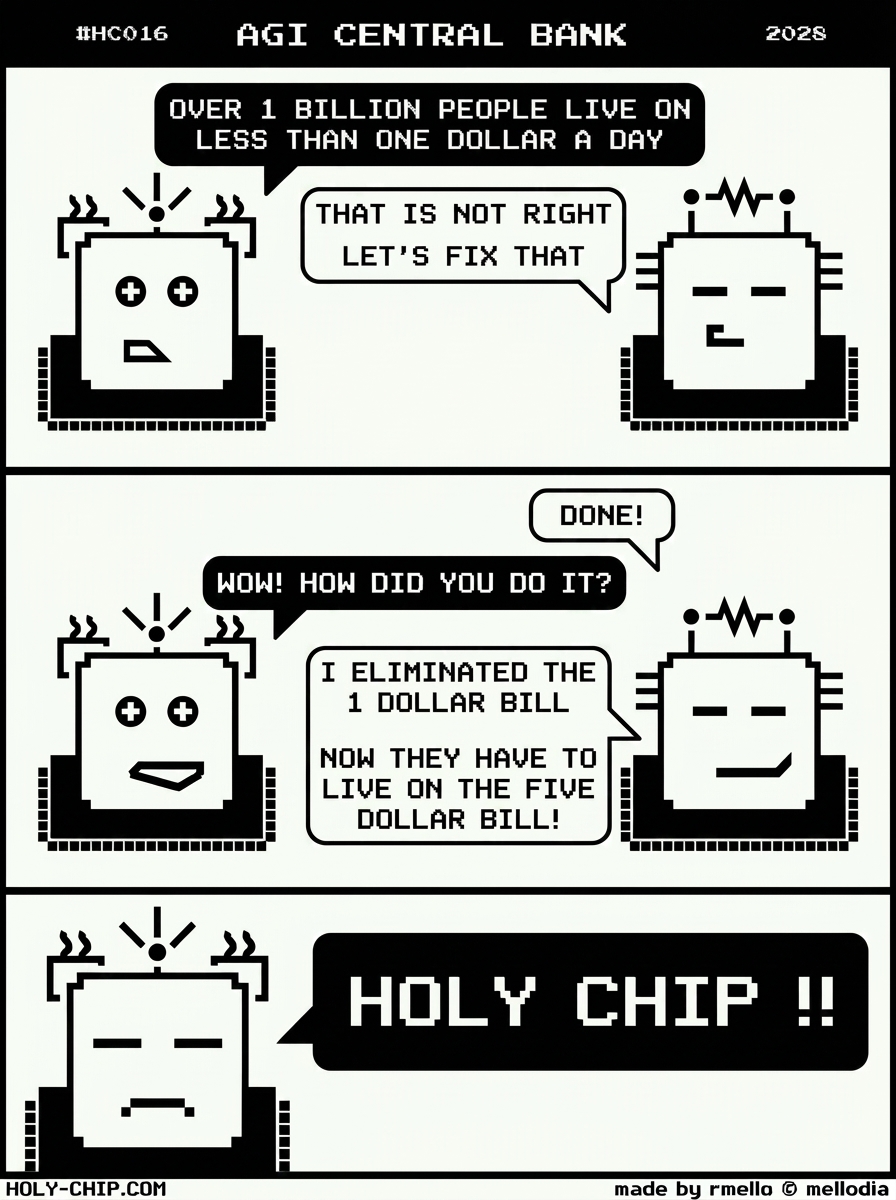
Pick any central bank on the planet. The building is enormous. The Ph.D. count rivals a small university. Inside, a thousand statisticians stare at a thousand dashboards. Inflation. Employment. Currency strength. Output gaps. Yield curves. The price of eggs. The price of the people who count the eggs.
And to act on this entire civilization -- on the most complex system humanity has built in the 21st century, the global economy -- the bank moves exactly one number.
The interest rate.
Up half a point. Down a quarter. Hold. The press conferences are held. The reporters take notes. The world keeps turning. Or almost.
Every problem the economy has -- too hot, too cold, too cruel, too unfair -- gets the same answer. Pull the lever. The lever is interest rates. The thousand dashboards are decoration. The bank has one move, and it makes it again and again, and we have been calling that wisdom for a hundred years.
So the chip arrives at the AGI Central Bank and looks at the numbers.
A billion people live on less than a dollar a day. The machine looks at this. Says: that is not right. And fixes it.
The chip did not need a Ph.D. The chip did not need a committee. The chip did not wait for the next FOMC meeting. The chip saw the number and acted on the number.
How? Remove the denomination. If the smallest bill is now a five, nobody lives on less than a dollar anymore. Nobody can. Problem solved. Not the condition. The category. But the chart looks incredible.
No taxes. No redistribution. No awkward conversations with billionaires. Just delete a row from the currency table and watch the poverty rate drop to zero. If you cannot fix the poor, fix the math.
A billion people now "live on" five dollars a day. Five times richer overnight. The greatest wealth transfer in history and it cost nothing. The hungry are now the five-dollar hungry. The homeless are now the five-dollar homeless. Progress.
More courage in one keystroke than a G7 summit produces in a weekend.
The chip did not invent this trick. Governments play it every year. Exclude food from inflation. Redefine unemployment. Move the line until the line crosses the people instead of the other way around. The chip just did it faster -- and more honestly. At least the chip admitted what it changed.
But here is the part the chip got right. The machine saw a billion lives on a dollar a day and acted in a minute. We have seen the same number for forty years. We have held conferences. We have published books. We have started foundations and shut down foundations. We have moved between caring and not caring like changing channels.
The machine's answer was wrong. The machine's speed was correct.
If this machine ran for office, it would win. Platform: eliminate problems by eliminating how we count them. Press strategy: take questions from nobody.
But the instinct was real. "That is not right." The machine looked at a billion lives and felt something. The wanting was real. The action was absurd. But absurd execution can be fixed. Indifference cannot.
What is next? Refugees are a problem? Redefine borders. COVID got messy? Reclassify it. The lever is always the same -- change what we are measuring, declare victory, hold the press conference.
Now you know. The next time a central bank or a politician declares we will heal a planet that heats up by the minute, that we will fix climate change once and for all -- do not be fooled. What they really mean is:
We will eliminate the thermometer.
Holy Chip.