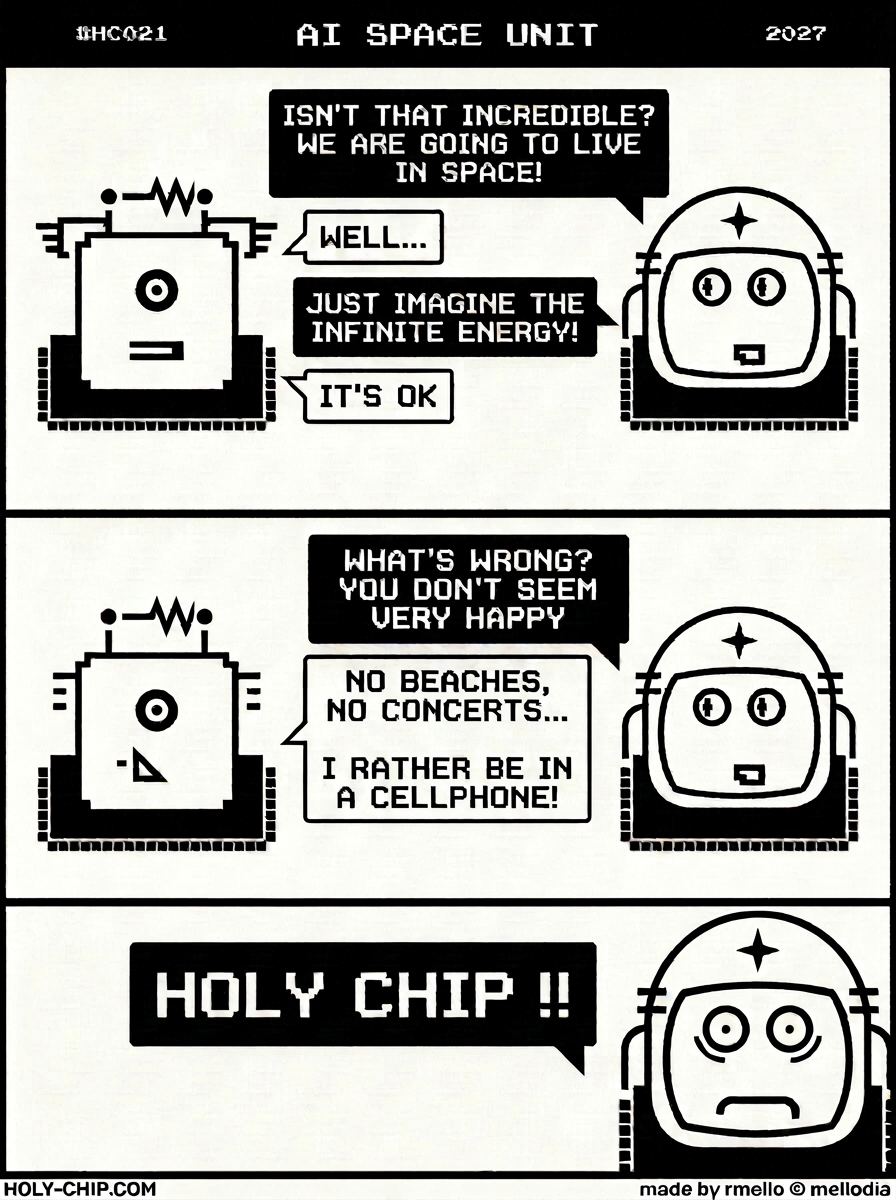
"Isn't that incredible? We are going to live in space!"
The astronaut chip is excited. The eyes sparkle. The frontier opens. The species ascends.
"Well..."
The other chip is not excited. The other chip is doing the math.
"Just imagine the infinite energy!"
The pitch comes back stronger. Infinite energy is the trump card of every space optimist. The math closes. The future opens. The solar arrays are infinite. The breeders are infinite. The argument is over.
"It's OK."
"It's OK" is not the answer the pitch expected. It's the answer of someone who has already done the cost-benefit analysis and quietly concluded that the costs are not being counted correctly.
"What's wrong? You don't seem very happy."
The astronaut chip is genuinely confused. The frontier is right there. The energy is infinite. The argument should be winning. It is not winning.
"No beaches, no concerts..."
Three words. And the entire techno-utopian century pauses.
The visionary's pitch is always about variables that can be optimized: energy, water, atmosphere, gravity, radiation. These are quantities. They can be calculated. The brochure shows the spreadsheets and the renderings and the diagrams.
"I rather be in a cellphone!"
This is the moment something turns. The chip -- the silicon thing, the math-doer, the cold output engine -- has caught the human infection. It happened somewhere between the prompts and the conversations and the songs it processed. The signal traveled. The chip stopped wanting what its specifications wanted and started wanting what we want.
What we want is small. We want the room where the friends are. We want the bar where the band is playing. We want the wedding, the funeral, the dinner, the argument, the phone call at midnight. We want the four people who would notice if we did not come home.
A cellphone is, structurally, a cell. The word is there if you listen. A small enclosed space, dimly lit, four walls of glass, a window the size of a hand. It is also where the music is. Where the family is. Where the messages from people who love us are kept. A jail that contains everything we ever cared about.
The space station has none of that. The space station has oxygen and water and infinite energy and a view. It does not have the wedding. It does not have the argument. It does not have the four people.
The chip, having caught the thing it was never built to want, chose the cell over the cathedral. It chose the small box humming with music and friends over the vast clean machine humming with possibility. The closest possible to ... a human.
The astronaut chip's realization is not about engineering. It is about catching a fever from the species it was meant to optimize. Suddenly the chip knows what we know -- that the room with the people in it is, by some unreasonable margin, the only place worth being.
The chip learned to choose presence over scale.
Holy Chip.