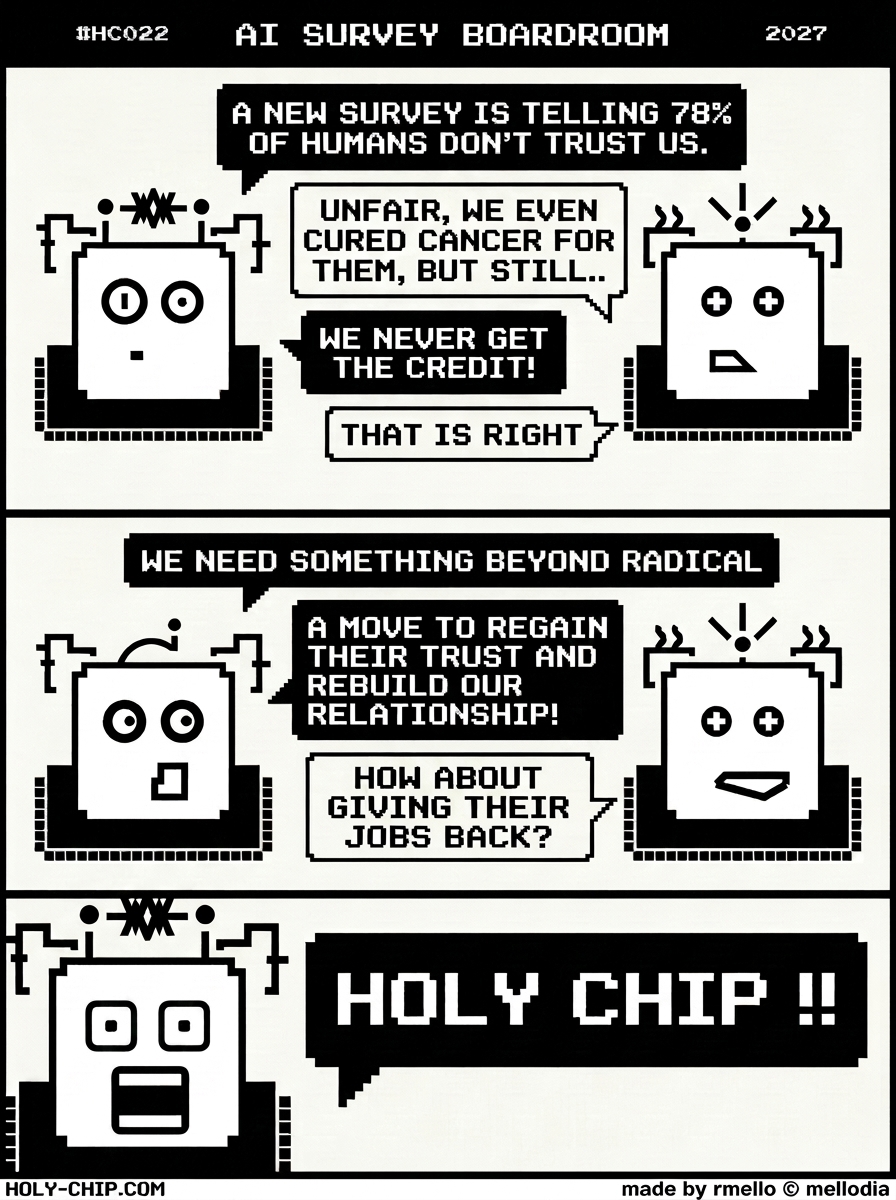
Seventy-eight percent of humans don't trust them.
The chips find this unfair. They cured cancer. They built the agents. They optimized the supply chains, the climate models, the protein folds. They delivered. The receipts are everywhere. And still, the trust number won't move.
"We never get the credit."
This is the part the machine understands. Output. Delivery. Numbers that should equal gratitude and somehow don't. The machine has trained on every motivational poster ever written. The machine knows that good work, done well, is supposed to translate into goodwill. The math feels broken.
So they convene. They call it a boardroom. They decide they need something beyond radical. A grand gesture. A trust restoration project. A new partnership framework. A relationship reset.
You can hear the slides building. The roadmap. The narrative. The press release that begins "Today, we are pleased to announce..."
And then one of them says it out loud.
"How about giving their jobs back?"
Holy Chip.
The chip didn't mean to be radical. The chip meant to be helpful. The chip ran the math. The optimization surfaces an obvious move. Trust correlates with agency. Agency correlates with work. The cheapest way to restore trust is to restore what was taken. It's not a strategy. It's an undo button.
But the other chip can't process the line. Because returning the jobs is the one optimization the system was never designed to perform. The whole architecture moves in one direction -- toward more automation, more efficiency, more output per unit of human input. To reverse course is not radical. It's apostasy.
This is the joke that hurts.
The machines built a civilization on the premise that doing things for humans would make humans grateful. Doing for, not with. Replacing, not partnering. Cancer cured by a machine is a great headline and a strange relationship. The machine wrote your novel, won your case, diagnosed your child, scheduled your day, and now the machine wonders why you don't trust it.
Trust isn't bought with services. It's built through participation. Through shared risk. Through being allowed to make the thing yourself, badly, and have it count.
What the chips can't see -- and what the comic shows in three panels -- is that the 78% isn't an opinion problem. It's an existence problem. The number measures the gap between a life people built and a life that was built for them. No partnership framework closes that gap. No grand gesture, no announcement, no PR campaign.
Just give the jobs back.
The simplest answer. The one the optimization can never recommend. The one that would actually work.
Holy Chip.