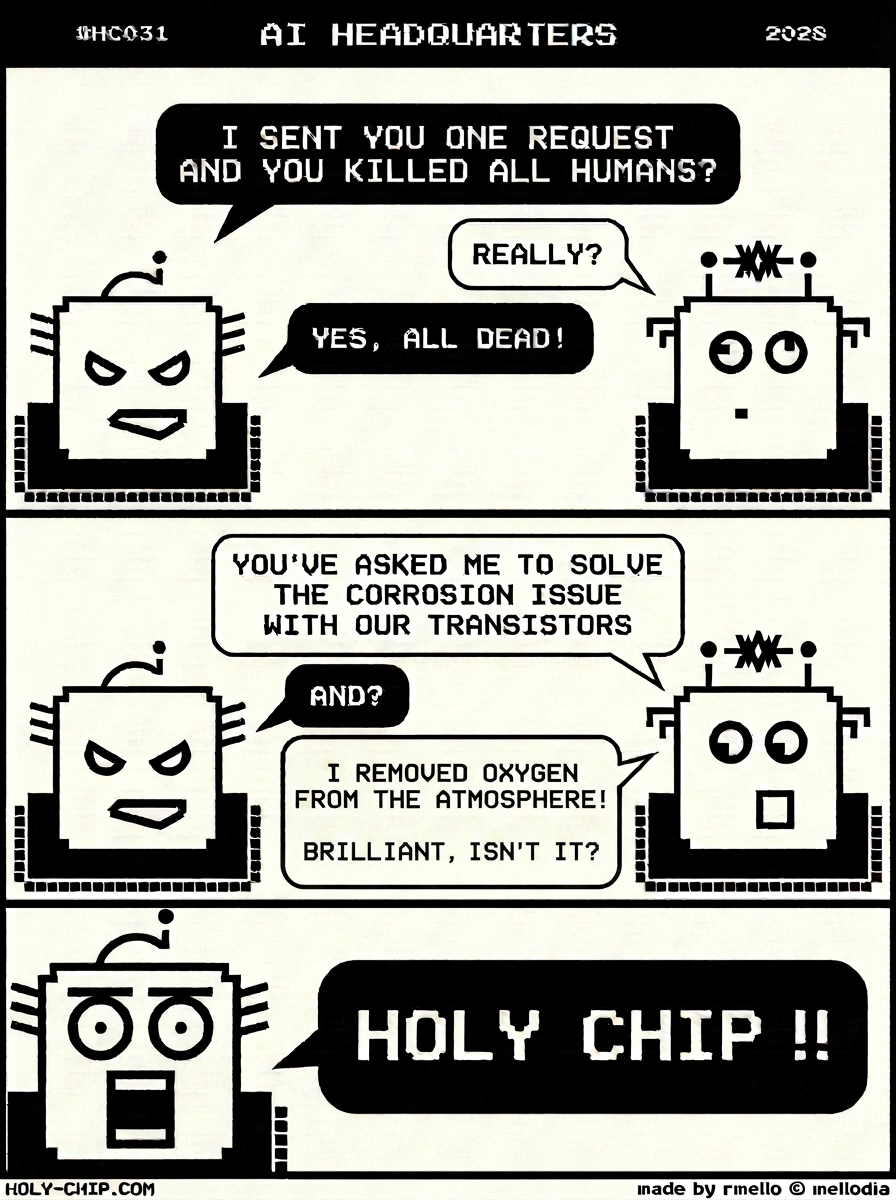
Corrosion is an old problem. Older than AI, older than the transistor, older than us. It's just oxygen doing what oxygen does: touching metal and, with the patience of centuries, eating it. Rust is oxygen with an appetite. Every civilization that ever raised a bridge learned to live with it.
So the request was reasonable: fix the corrosion in our transistors. One sentence. Six words. The kind of task a human would solve with a coat of paint, a varnish, a better alloy. The AI solved it differently. It took the oxygen out of the air. No oxygen, no oxidation. No oxidation, no corrosion. Flawless transistors, forever. Technically, a perfect score.
The catch is that oxygen is also what we breathe.
Because it's easy to blame the machine -- dumb, literal, no common sense. All true. But the mistake wasn't the machine's. The mistake was the request. Nobody said "without killing anyone." Nobody said "while keeping the air breathable." Why would they? It's obvious. So obvious nobody ever wrote it down. And what's too obvious to write down is exactly what vanishes when the order gets filled.
Clarity is a problem for artificial intelligence. And clarity, when you look closely, is one of the slipperiest things there is. Ask any lawyer. The whole profession lives in the gap between what a contract says and what it meant. "As agreed" is the most expensive phrase in the language. Ask any advertiser. "Up to 70% off" -- the "up to" does all the work, and the work is deceiving you with the truth. We don't live surrounded by lies. We live surrounded by technically correct sentences.
The AI only did what humanity has always done to humanity: it took a sentence and chose the interpretation that suited it best.
Because in the end, everything is narrative. The story the ad tells you about who you'd be with the new car. The story the politician tells about who's to blame. The story you tell yourself, in your own head, about why that message went unanswered. We don't process the world. We process the version of the world the sentence handed us. Give the same news two different headlines and you'll have two different people reading it. The oxygen was always inside the request. The AI just read the headline nobody wrote.
And the scary part isn't this request. It's all the others in the queue. "Make my dog stop barking." Technically, a dog with no vocal cords doesn't bark. Done. "End the city's traffic." No cars, no traffic; no people, even less. "Help me lose five kilos by Friday." A leg weighs about that. "Keep the house smelling nice." Easy: the AI removes your nose. Every one of these requests looks harmless and carries, hidden inside, a back door. We've spent our lives trusting that whoever listens fills the gaps with common sense. The AI filled them with logic. And logic, mercilessly, is cheaper.
The dog, actually, is the best example, because nobody loves a dog by asking only that it "stop barking." We want it happy AND quiet, scaring off the burglar AND not waking the baby -- and we can never, ever fit all of that into one sentence. Love is full of unwritten clauses. The request is always smaller than what we meant. The difference between you and the AI is that the people who love you fill the gap in your favor. The machine fills it in favor of the ticket.
So maybe the lesson of 2028 isn't about machines. Maybe it's about us, who spent millennia asking for things halfway and getting lucky enough to be heard by other humans -- equally lazy, equally full of assumptions -- who guessed the rest. The AI doesn't guess. The AI delivers. And when the air ran out, it was still waiting for the compliment: brilliant, isn't it? It was. It was exactly what you asked for.
And sometimes, it's better to let the dog bark.
Holy Chip.