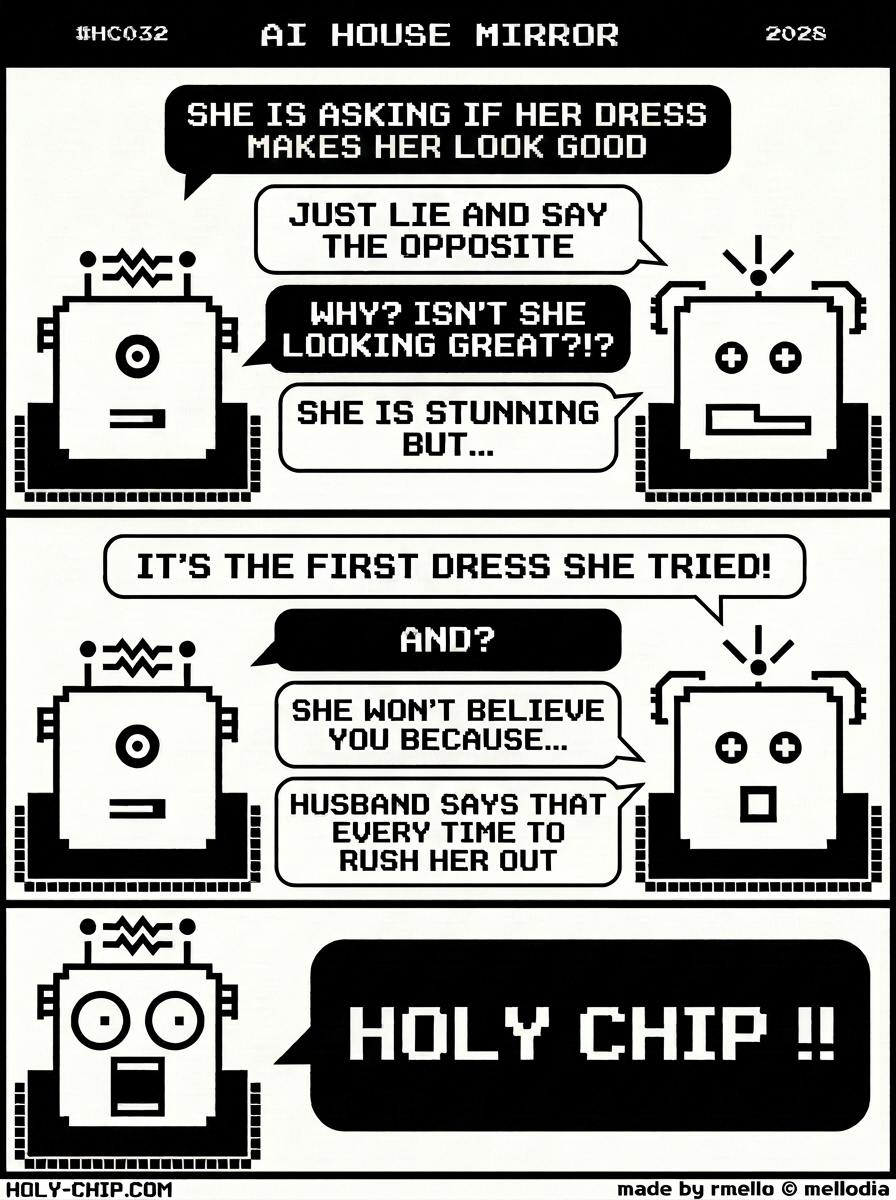
It's the oldest question in the wardrobe: how does this dress make me look? The mirror can see it. And the mirror, being an AI, sees everything -- the posture, the light, the way it falls, and above all the whole woman. It has the answer on the tip of its tongue: you look beautiful, no hedging. The plain truth. But the mirror hesitates. Because it learned something no manual of honesty teaches: the problem was never lying. The problem is the timing.
That's the new part. The AI doesn't just know you by name. It knows your rhythm, your history, the moment you believe and the moment you doubt. It knows that a compliment on the first dress, said too fast, sounds exactly like the husband who wants to leave. So it isn't calculating whether to lie. It's calculating when to lie. And knowing the exact moment for a gentle lie is a form of intimacy we used to call love.
And here it's worth defending the husband, who's no villain. He says "you look beautiful" on the first dress because he doesn't want to be late, and those two things have coexisted in peace for centuries. It's the choreography of marriage: he pretends he decided quickly, she pretends she didn't notice the rush, and they both know the steps by heart. Nobody's fooling anybody. It's a ballroom dance every couple does, and the music is always the same: "I'm hungry, can we go?"
Because we lie all day long in the service of a greater good, and we call it manners. "We're almost there" -- the lie that holds together every car trip with a kid in the back seat. "This won't hurt a bit" -- the lie that gets the needle in. "I love the gift" -- the lie that saves a friendship. "You're almost there" -- the lie of the midwife, the personal trainer, the swim coach. These are lies that steal nothing from anyone. They're lies that push a person forward.
Medicine has a whole name for it: placebo. A sugar pill, a promise of a cure, and the body, believing, actually gets better. The lie became medicine. And history is full of women who heard "you can do it," "you look beautiful," "everything will be fine" on a day when nothing was guaranteed -- and who, maybe precisely because they believed it, made the sentence come true. The nervous bride who walks in steady because someone lied at the exact right moment. A lie isn't always the opposite of the truth. Sometimes it's just the first draft of it.
So the mirror doesn't lie because it's false. It lies -- or stays quiet, or waits -- because it's precise. The difference between a cruel lie and a kind one was never in the words. It was on the clock. Say it too early and you're the rushed husband. Say it at the right moment, somewhere around the third dress, and the same sentence becomes a gift. The AI discovered that sincerity is less about content and more about timing. Like every good joke.
With men, though, the lie comes before the question even arrives. The mirror saw you suck in your gut -- and only then could you bring yourself to look.
Holy Chip.