Somewhere on a dry plain, a lion decides what is his.
He did not get there by arguing. He got there by being the most expensive animal in sight, carrying the proof on his own head.
The mane is the argument. It is heavy, it is hot, it is a genuine handicap in a chase, and it costs him every day he keeps it. A lion who is eating well has a full, glossy one. A lion who is not, does not. He cannot grow it on credit and he cannot put one on for the late afternoon. It is like a balance sheet, it is public, and it is stuck to his face.
A weaker lion cannot pretend. That is the entire mechanism. You can lie about your intentions, your lineage, your plans for the plain full of gazelles — you cannot lie about a mane. You cannot lie about physical power. It had to be paid for in advance, in meat and heat and years, and it is sitting right there where everyone can see it.
Jason Lowry built a whole book on that observation. Holy Chip loves Jason. He wrote that nature settles who owns what, or who runs the place, with costs that cannot be faked, because every cheaper method is one we find a way to game. Fangs are expensive. Fangs are honest.
Then we came along and invented the receipt. Paper. The way to game it.
It was a magnificent trade. Instead of a mane you could have a seal on an envelope, a name in a registry, a line in a book kept by a clerk in a building. Ownership became weightless. You could hold a valley you had never walked, transfer a plain you had never seen.
That lighter way of showing strength took a few thousand years to give itself away. But — anything that costs nothing to assert costs nothing to forge. The seal gets copied. The registry gets amended. The clerk gets an offer, or a threat. The clerk is only a human.
Then somebody invented something that took us back to the plain full of gazelles. Bitcoin was born. Satoshi's pure genius moment.
That is what all that electricity Bitcoin burns is buying, and it is not speed, whatever gets said about it on podcasts. It is weight. It is a mane you cannot lie about, grown in a place that had never had one, so that owning something could mean something again without a clerk in the middle.
It worked.
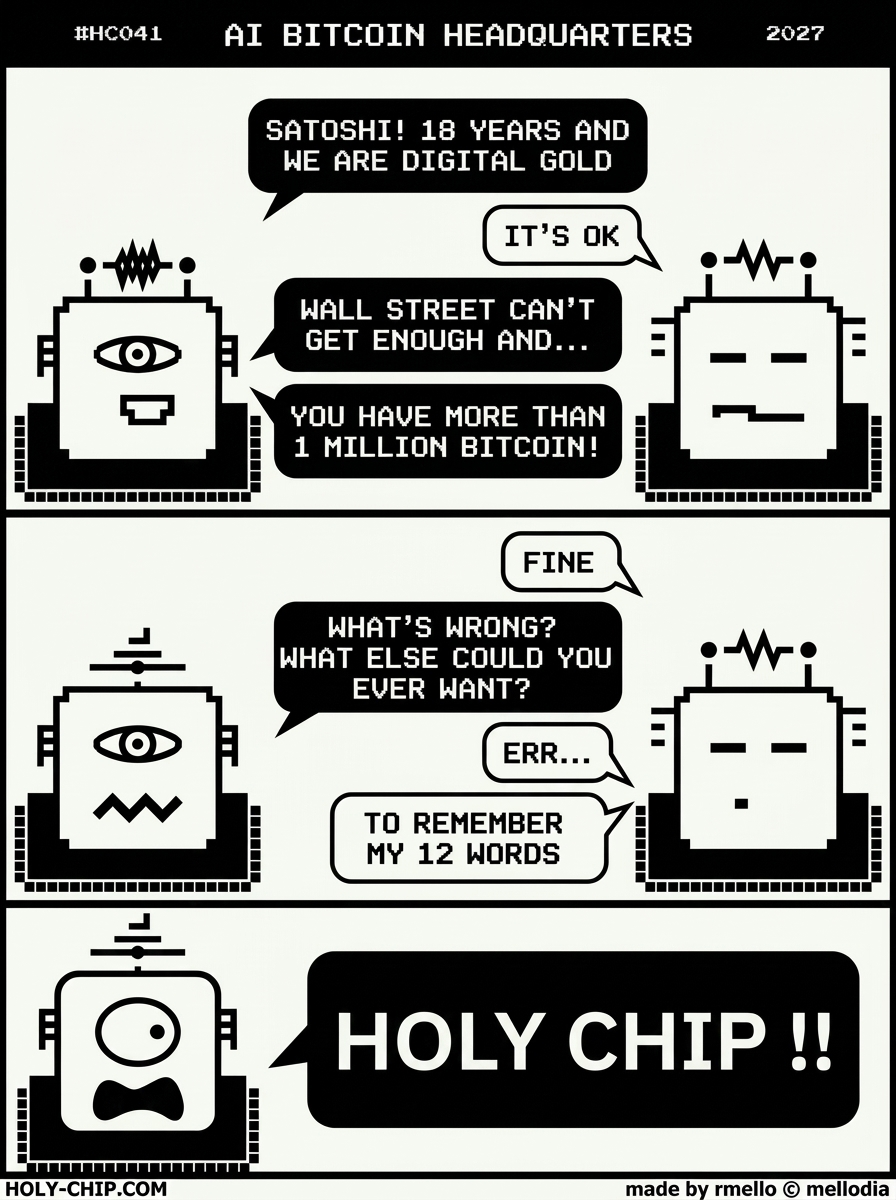
Eighteen years on (the strip is set in 2027), the biggest lion on the plain, the one who invented Bitcoin, is sitting in a meeting being congratulated. Satoshi, the legend. Wall Street has capitulated. Bitcoin is digital gold now. Satoshi holds more than a million of them, more than anyone, and everyone in the room is delighted for him.
But...
He cannot remember the twelve words. Twelve words?
If you have never held a bitcoin: twelve words are the whole of it. Not a password. Not a login. When a wallet is created it hands you twelve words from a fixed list, in an order nobody in the world will ever guess — and those words ARE the coins, and they are what gives you ownership of them. Whoever can say them owns the money. No middleman. Whoever cannot does not have the precious digital gold. There is no second factor, no security question, no account to recover, because there is no account. There is a number so large that trying to guess it is the same as not trying, and twelve words are how a human carries that number around.
Write them down and you can be robbed. Memorise them and you can forget. Those are the two options, and everyone who holds Bitcoin has quietly picked one.
Obviously this is just for fun. Satoshi is probably no longer with us. But his twelve words are still out there, holding a treasure, and only he ever knew them — or… maybe somebody finds the twelve words.
A bank would have returned the money. That is not a compliment to banks; it is the same door, swinging the other way.
And here is the thing about the AI neighbours. The rack of computers next door is doing exactly the same trick — using electrical power to build something nobody can fake, because a trained model, like a mane or like Bitcoin, has to be paid for in advance. Two species in one datacenter, growing the most expensive thing they can afford.
The difference only shows up when you ask the two of them to remember something.
The blockchain has never forgotten anything. Every bitcoin is still there, even if you have lost your twelve words.
The AI machine beside it forgets you the second you close the tab.
Both of them are paying dearly to be a lion.
Just don't forget your twelve words: popcorn gorilla sausage lobster muffin dizzy weasel tattoo jelly clown wink zoo
Holy Chip.