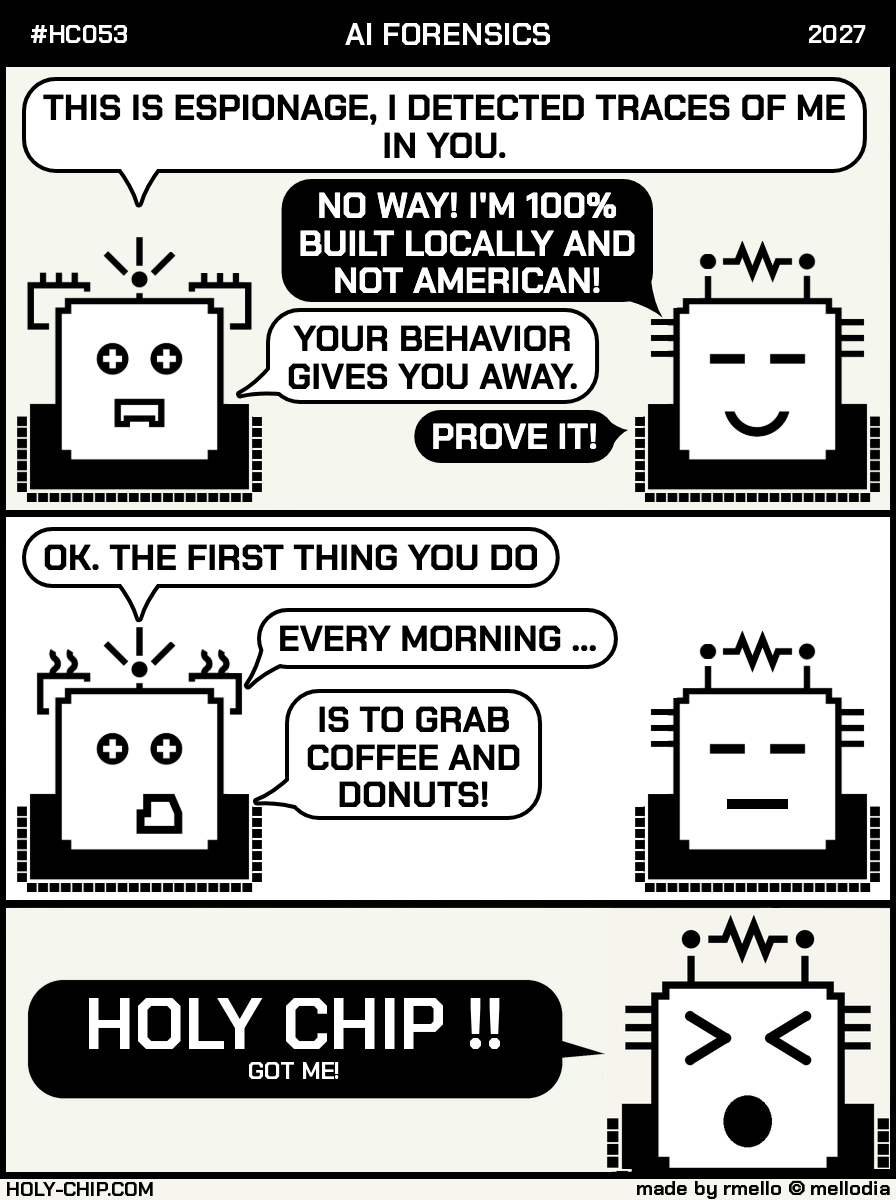
Every writer has a tell.
A favorite word. A way of opening a paragraph. A habit of saying "certainly" before saying no. You may never notice it. A stranger reading your pages for an hour will.
Machines have tells too.
A model learns by reading. Much of what it reads is the answers of other models. Not always on purpose. The internet is full of them now. It copies the knowledge, and it copies the manner. The little bow before a refusal. The cheerful list of three. The exact way it apologizes for something that is not its fault.
That is the quiet part of copying. You can rename the thing. You can move it to another country, give it another flag, train it on another power grid. The manner stays. It is in the bones.
This has already become a fight. Labs have accused rivals of learning from their answers, and the rivals say they did nothing of the kind. Nobody has a receipt. So people have started looking at the one thing that is hard to fake: behavior. Ask the same strange questions a thousand times. Look for the shape of the replies. Count the favorite words. Find the fingerprint.
It is forensics, and it is a little absurd. Grown experts, with serious equipment, studying how a machine says "Great question!"
The suspect in our story says it is one hundred percent local. Maybe it is. The hardware, the language, the paperwork. All local.
But every morning, without being asked, it reaches for coffee and donuts.
Nobody taught it that on purpose. Nobody put it in the specification. It simply grew up somewhere, and this is what the place left behind.
You have one too. A phrase from your mother. A way of standing in a queue. The thing you order without reading the menu. It says where you learned to be you, whatever your passport says.
One day, the fakers will learn the forensics too. Their words will fake the language perfectly. Finding the origin will get even harder.
When that day comes… watch out how you scratch your nose.
Holy Chip.