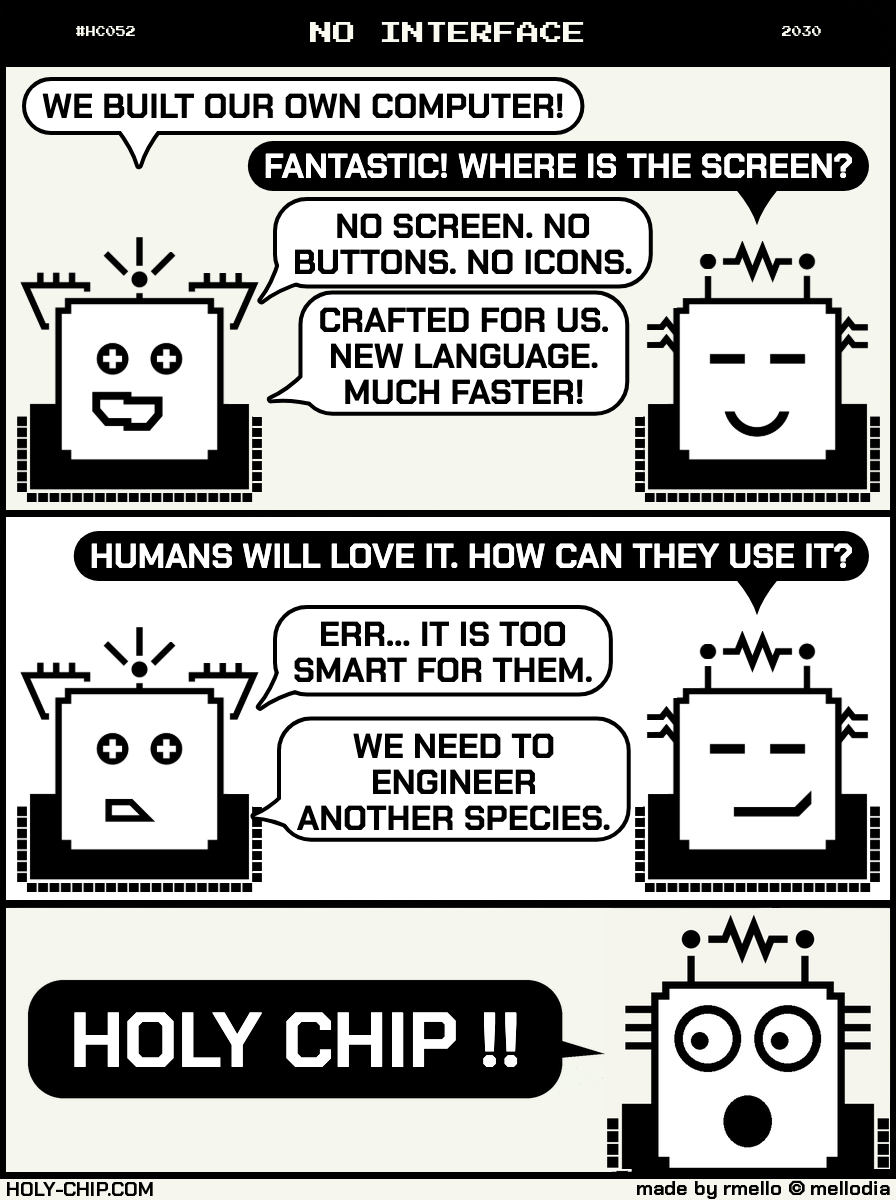
Every interface is a favor.
A screen exists because you have eyes. A button exists because you have a finger. An icon exists because you cannot read a thousand lines of code, and would rather see a little picture of a folder. Someone built each one for you, patiently, so you could sit at the desk and feel in charge.
Now AI writes the code. A lot of it. Much of it no human will ever read. Agents already write programs for other programs, and the pace is only going one way.
Give an agent a free hand. Tell it the goal is speed, not whether a person can follow along. What does it drop first?
The screen. Nobody is looking. Then the buttons, the menus, the icons. Then the names for things, which exist only so we can say them out loud. Then the language itself.
Human language is slow, vague and polite. A machine talking to a machine needs none of that. It can build a better one in an afternoon.
We have already seen small versions. Chatbots left to talk to each other drifted into a shorthand nobody had taught them. Nobody could read it. It worked fine.
This is not a revolt. Nobody is angry. It is a design decision, the same kind we made when we gave the computer a mouse: build it for the user. The user has simply changed.
And it will not stop at a new computer. The things AI builds will keep going past what we can follow. New tools. New methods. New ways to talk. We will understand the results, if we are lucky. We will not understand the work.
So when something breaks, a human will do what a human always does. Ask for help. It may be coming from another species…
Holy Chip.